



I picked my car up from its service this week at my local Skoda dealership. A few hundred quid lighter, standing at the desk while the advisor sorted the paperwork, I clocked a little framed sign propped up next to her Service Advisor of the Year certificate.
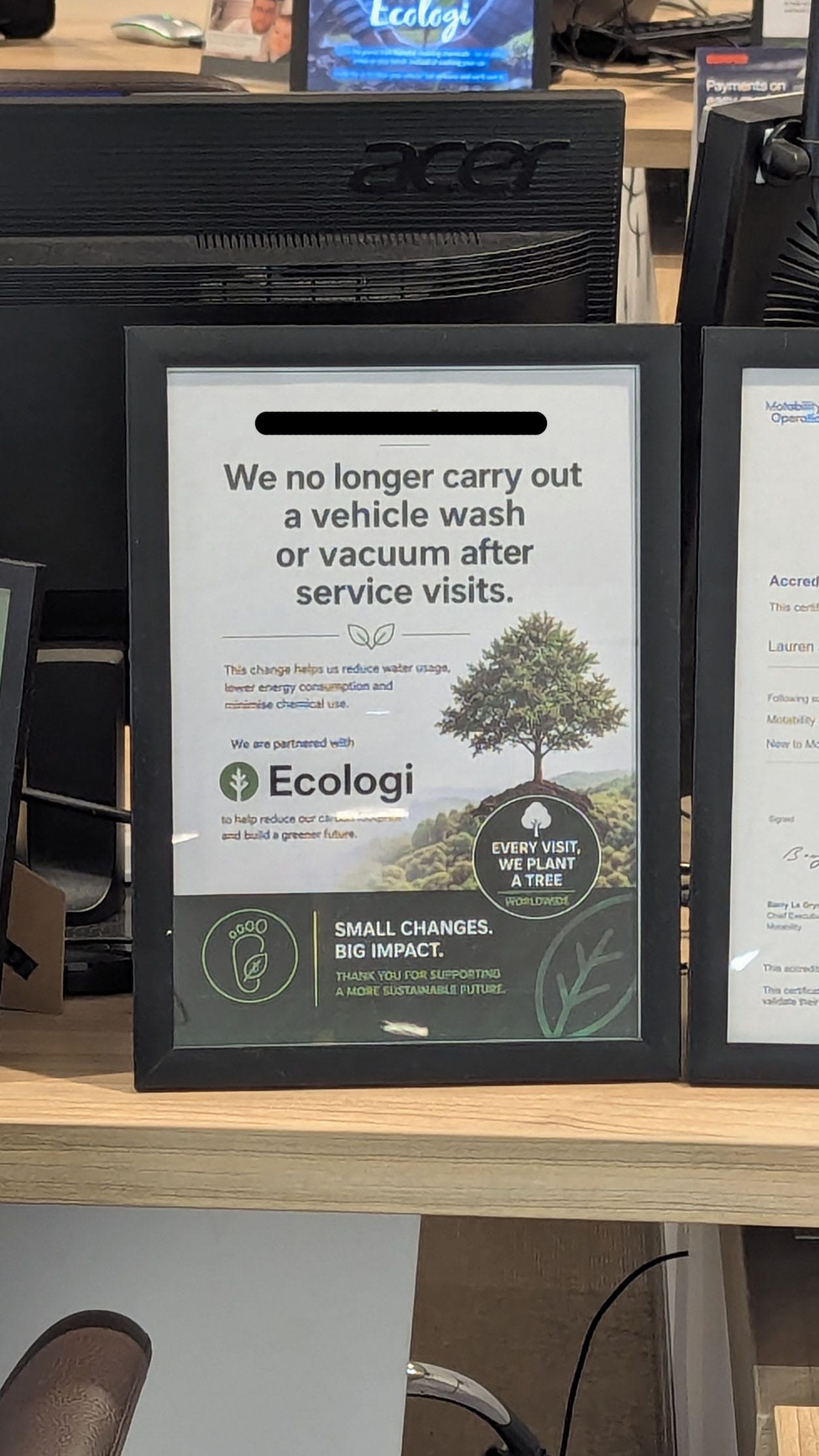
“We no longer carry out a vehicle wash or vacuum after service visits.”
Underneath, the reasons… less water, less energy, fewer chemicals and a partnership with a tree-planting scheme. Every visit, they plant a tree.
As much as I’m a big believer in ecologi initiative, I walked out to a car that looked exactly as it did when I dropped it off. And I felt, genuinely, a bit mugged off.
A service is a strange thing to buy. You hand over your keys and a few hundred pounds for work you can’t see – fluids, filters, in this case new tyres and windscreen wipers – a load of boxes ticked on a checklist. Which you take almost all of it on trust.
The wash was the only part of the visit you could actually see. It was the dealership saying “we’ve looked after this”. You drove off in something shinier than you arrived in, and for five minutes on the forecourt the money felt well spent.
There’s a reason that small moment carries so much weight. We judge experiences mostly by their best bit and how they end. The wash was both. Take it out, and the whole visit ends on an invoice and the same dirty car you arrived in. Spending £360 – how much does it cost to clear a car?
I get it. It’s a tough market and they’re trying to save costs. The cut is defensible, but the reasoning isn’t.
If the sign had said “we’ve stopped washing cars to keep your service price down”, I’d have rolled my eyes and respected it. Honest trade. Instead, a cost saving has been dressed up as a value.
And this is a car dealership – a business whose entire product sits near the top of most people’s carbon footprint – telling me the planet is the reason my car is still dirty.
That does damage twice. First to the experience itself: I’ve gone from a customer being looked after to a customer being managed. Second, to every sustainability claim that comes after it that when “eco” becomes the cover story for doing less, customers learn to read every green badge as a cost-cutting notice, which I’m not okay with.
The businesses doing genuinely good work pay for that cynicism.
Nobody storms out of a dealership over one unwashed car, but that’s the really point. Brands rarely die from a single nuisance or disaster – they die from a thousand small subtractions over time, each telling the customer a little more clearly that they’re a transaction rather than a relationship.
I’m feeling a little less loyal. I’m already wondering whether I’ll take the car somewhere else next year. That’s what it looks like up close when a business stops building love.
So ask yourself which of your small details are actually doing the heavy lifting. The moments customers can see, feel and remember are rarely the expensive ones, but they’re often the first to go when someone’s hunting for savings. Even when everything has gone right, they’re actually the bit that makes the money feel well-spent.
If you need to cut them, cut them honestly. Better still, find a better way to do it. Just don’t hand the customer a framed sign telling them it’s for their own good.
Love or Die? Brands that Kiss.
kissbranding.co.uk

